

Ghana’s cocoa marketing architecture is one of the most frequently discussed, yet widely misunderstood, institutional systems in global commodity trade. In media commentary, parliamentary debate, and industry conference panels alike, the mechanics of how Ghanaian cocoa moves from farm gate to international buyer are routinely reduced to oversimplified narratives. The purpose of this piece is not to defend any single institution, but to set out the operational realities that shape, and should inform, every serious conversation about Ghana’s cocoa sector.
At its core, Ghana’s cocoa marketing system is defined by institutional coordination. It is neither a free market nor a command economy. It is a structured, rules-based system in which different actors fulfil discrete and interdependent functions across a vertically integrated supply chain. Farmers produce the raw commodity. Licensed Buying Companies handle domestic procurement under conditions set by regulation. Quality assurance systems operate to preserve the physical and reputational integrity of Ghanaian cocoa at every stage of the pipeline. And the Cocoa Marketing Company, CMC, functions as the exclusive commercial interface between Ghana’s cocoa supply and the international market.
This division of roles is not a relic of a bygone era. It is the deliberate architecture through which Ghana has maintained one of the most bankable and reputable cocoa origins in the world for over seven decades. Buyers from multinational chocolate manufacturers to commodity trading houses to artisanal bean-to-bar producers transact through CMC because the system provides something increasingly rare in global agriculture: counterparty certainty, quality consistency, and institutional credibility.
Yet the very complexity of this system makes it vulnerable to mischaracterisation. When the purchasing function is conflated with the marketing function, or price-setting mechanisms are mistaken for trading strategy, the result is a distorted public conversation. That distortion carries real consequences: it misinforms policy, confuses investment analysis, and weakens the confidence of international buyers who depend on clarity and predictability from origin-country institutions.
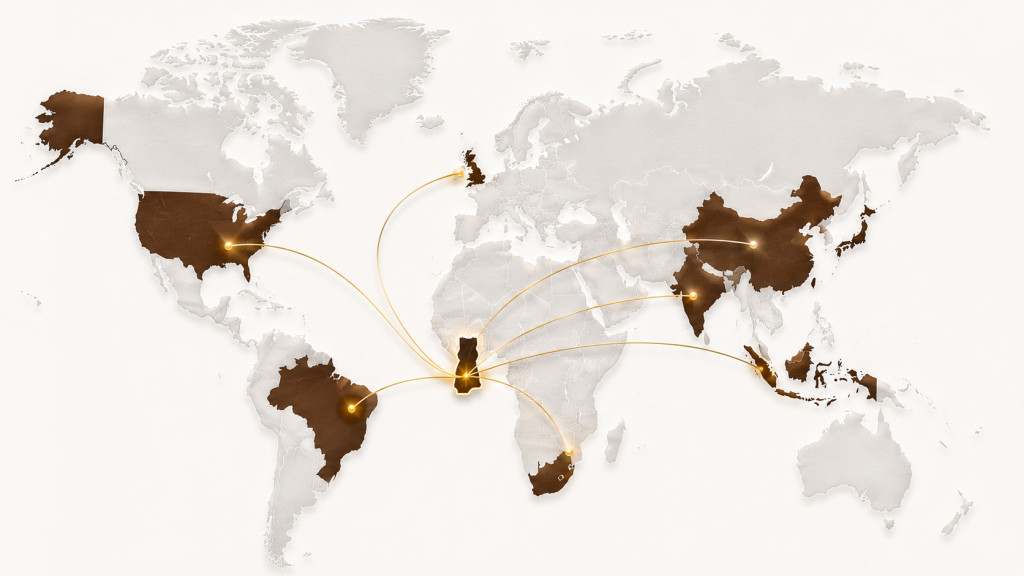
The commercial distinction is significant. CMC does not merely broker transactions. It manages a forward sales programme tied to global price benchmarks, principally ICE London. It structures contracts, manages counterparty risk, handles logistics coordination, and ensures delivery performance across dozens of markets. These are functions that demand both institutional continuity and real-time market intelligence. They are not reducible to a single headline or political sound bite.
Understanding Ghana’s marketing system is also essential to supply chain planning at the processor level. Unlike origins where spot market fragmentation introduces delivery uncertainty, Ghana’s coordinated system provides the long-horizon visibility that large-scale blending operations require, particularly as compliance environments tighten under frameworks such as the EU Deforestation Regulation. The bankability of Ghanaian cocoa is not incidental; it is the product of institutional design.
Any reform conversation must therefore be grounded in a rigorous understanding of what the current system actually does. Ghana’s cocoa marketing model represents a form of industrial coordination that has delivered tangible results: reliable foreign exchange earnings, sustained buyer confidence, a global quality premium, and decades of market continuity. Assumptions shaped by incomplete narratives, however well-intentioned, are a poor foundation for policy.
In the media space, there is an opportunity to raise the quality of public discourse. CMC is committed to demystifying the cocoa marketing process through structured engagement, editorial briefings, and fact-based exchanges. The cocoa sector is too important to Ghana’s economy for public understanding to remain hostage to guesswork or speculation.
In an era when agricultural commodity systems face unprecedented scrutiny from regulators, civil society, and consumers, Ghana’s cocoa marketing framework deserves to be understood on its own terms, as a system of coordinated excellence, not bureaucratic opacity. And it is the responsibility of the institution charged with bringing Ghanaian cocoa to the world to make that understanding accessible to every stakeholder with a stake in this sector’s future.
Cocoa is not just a commodity. In Ghana, it is a national institution. And institutions earn trust not only through performance, but through transparency.